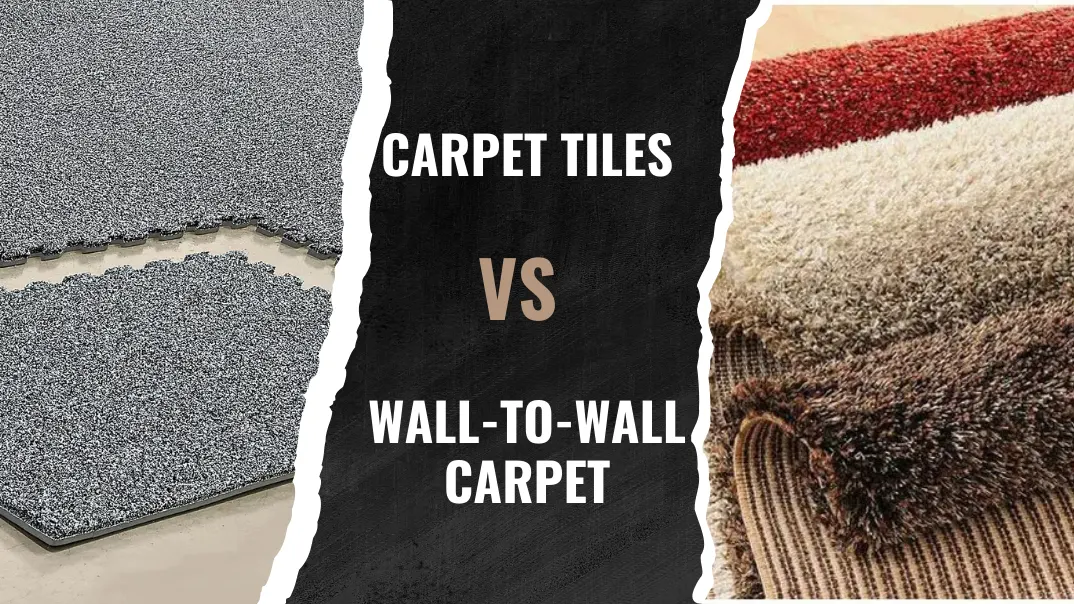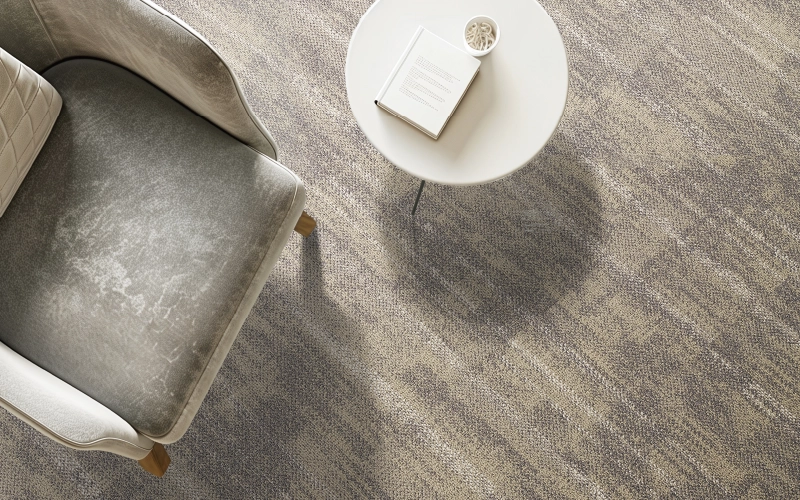
Choosing carpet tiles for schools is not simply a matter of selecting a color that looks good in a classroom or choosing the cheapest commercial flooring available.
Schools are complex environments.
A classroom may need a comfortable and quiet floor for everyday learning. A corridor may experience thousands of footsteps every week. A library may prioritize acoustics and atmosphere, while an entrance area needs to cope with dirt, moisture and heavy traffic.
This means that one carpet tile specification may not be suitable for every area of a school.
The better approach is to divide the building into functional zones and evaluate carpet tiles according to traffic, cleaning requirements, acoustic needs, appearance, installation conditions, maintenance and replacement requirements.
This guide explains how to choose carpet tiles for schools, what specifications to compare, which materials and backing systems to consider, and what school project buyers should ask manufacturers before placing an order.
Why Are Carpet Tiles for Schools Becoming a Popular Flooring Option?
Carpet tiles have several characteristics that make them practical for educational environments.
Unlike broadloom carpet, carpet tiles are supplied in modular pieces. If one area becomes damaged or heavily stained, individual tiles can potentially be removed and replaced rather than replacing the entire carpeted area.
This can be particularly useful in schools, where flooring is exposed to continuous daily use.
The main advantages include:
Modular installation
Easier replacement of damaged areas
Flexible design possibilities
Reduced material waste during installation
Easier transportation and handling
Ability to create different visual zones
Compatibility with commercial interiors
Potentially lower maintenance disruption
However, these benefits should not lead to the assumption that every carpet tile is automatically suitable for education projects.
The right carpet tiles for schools should be selected according to the specific zone and project requirements.
Should the Same Carpet Tile Be Used Throughout a School?
Not necessarily.
One of the most common mistakes in school flooring projects is selecting one carpet tile for the entire building simply because it simplifies procurement.
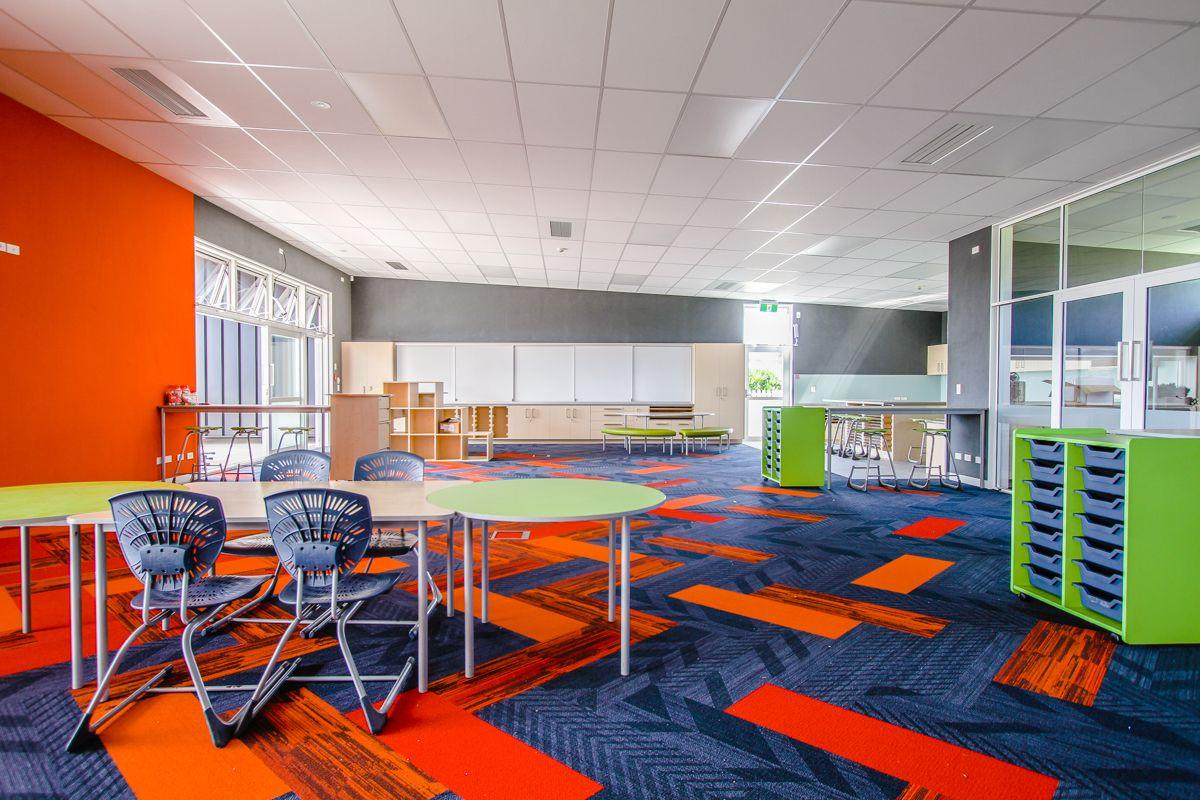
A better strategy is to create a zone-based carpet tile specification.
For example:
| School Area | Typical Requirement | Important Considerations |
|---|---|---|
| Classroom | Medium to heavy traffic | Comfort, acoustics, stain resistance |
| Corridor | Heavy traffic | Wear resistance, cleaning, appearance retention |
| Library | Medium traffic | Acoustics, comfort, visual atmosphere |
| Reception | Medium to heavy traffic | Appearance, durability, maintenance |
| Administration Office | Medium traffic | Professional appearance, comfort |
| Teacher Room | Medium traffic | Comfort, maintenance |
| Meeting Room | Medium traffic | Acoustics and appearance |
| Learning Commons | Heavy traffic | Durability, zoning, flexibility |
| Entrance | Very heavy traffic | Dirt, moisture, cleaning |
| Multipurpose Room | Variable | Flexibility and maintenance |
The objective is not necessarily to use ten different products.
Instead, the objective is to understand why a particular product is appropriate for a particular area.
In many projects, one or two carefully selected carpet tile constructions may cover multiple zones.
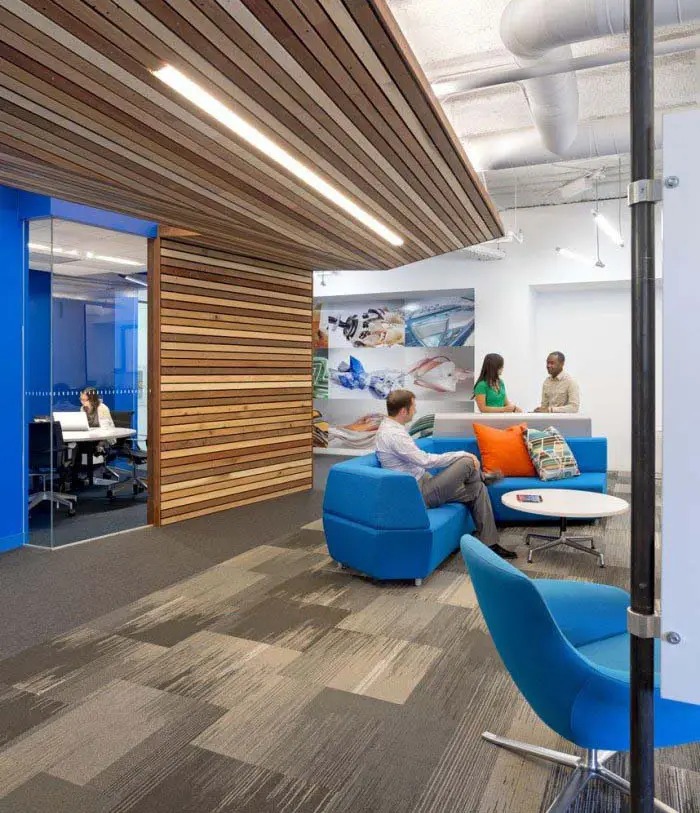
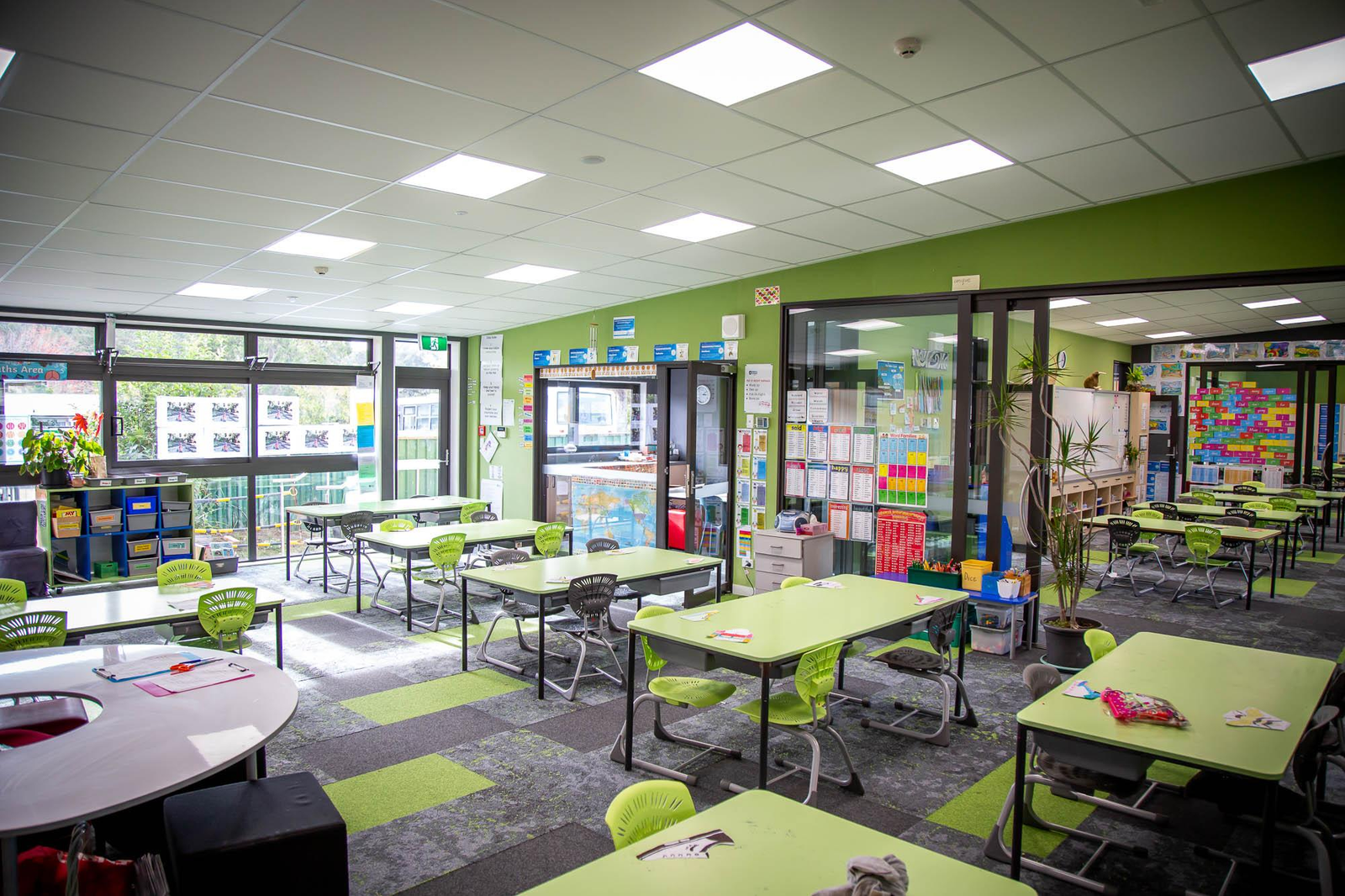
1. Carpet Tiles for School Classrooms
Classrooms are one of the most obvious applications for educational carpet tiles.
However, classroom flooring needs to balance several requirements.
Students and teachers may spend several hours in the room every day. Furniture can be moved repeatedly, chairs can create localized wear, and food or drinks can occasionally be spilled.
At the same time, the room should feel comfortable rather than industrial.
Key considerations for classrooms
Traffic
A classroom may not experience the same continuous foot traffic as a main corridor, but it can still receive substantial daily use.
The flooring specification should therefore consider:
Frequency of use
Number of students
Furniture movement
Chair movement
Expected service life
Cleaning frequency
Acoustic environment
Sound management can be important in classrooms.
Hard flooring can contribute to a more reflective acoustic environment, whereas textile flooring can help create a softer interior surface.
However, acoustic performance should not be assumed solely from the fact that a product is carpet.
The complete flooring assembly, backing construction, subfloor and installation method can influence actual performance.
Stain and maintenance
Classrooms are vulnerable to:
Food spills
Drinks
Ink
Dirt
Mud
Craft materials
General student activity
Therefore, a carpet tile should be evaluated for practical cleaning and maintenance requirements rather than simply advertised as “easy to clean.”
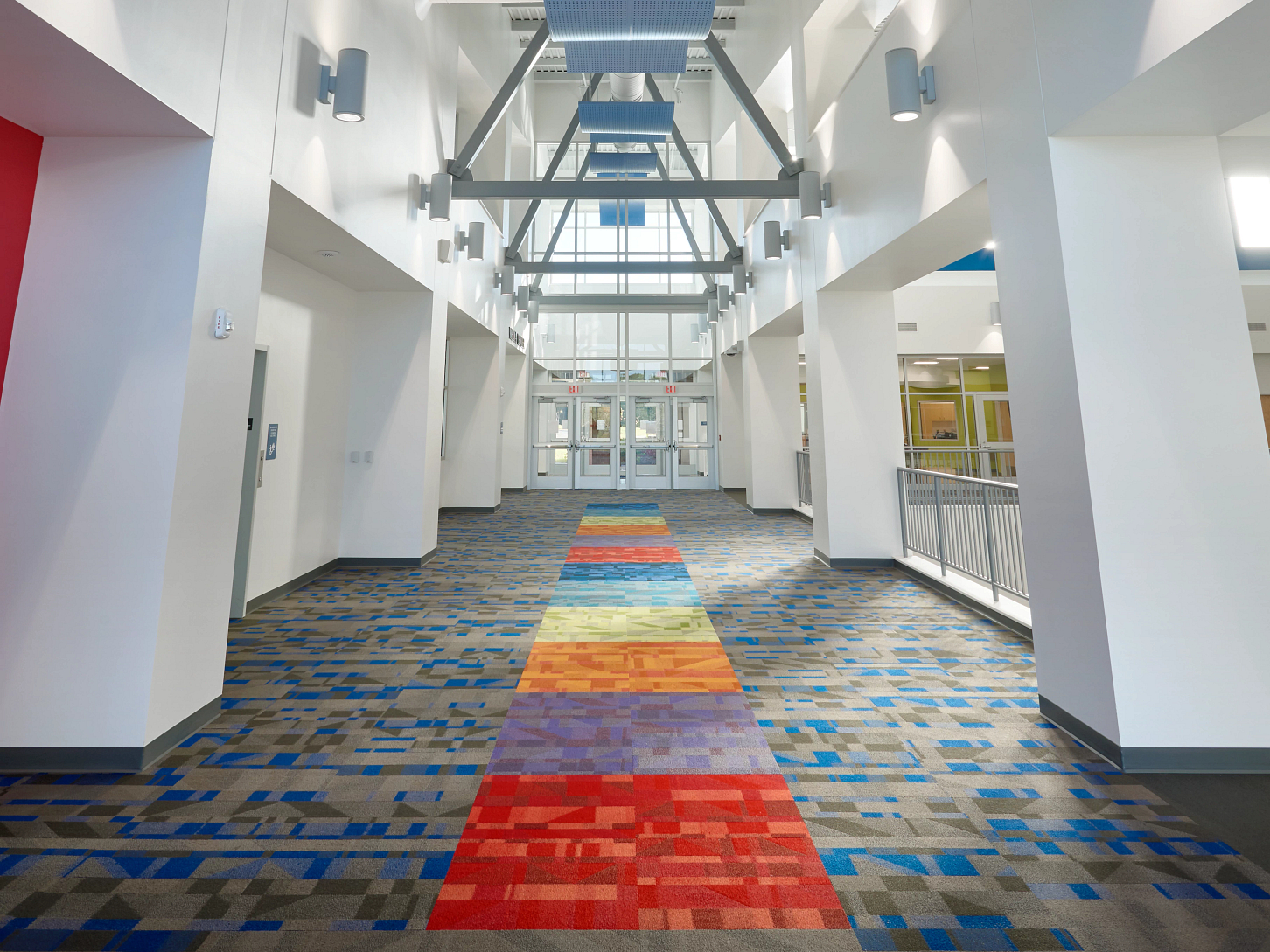
2. Carpet Tiles for School Corridors
Corridors are completely different from classrooms.
They can represent some of the highest-traffic areas in a school.
Students move between classrooms throughout the day, teachers move equipment, and cleaning staff repeatedly pass through the same routes.
This makes traffic and wear resistance particularly important.
What should you evaluate?
Before selecting carpet tiles for school corridors, consider:
Expected pedestrian traffic
Directional traffic patterns
Entrance proximity
Cleaning frequency
Furniture or equipment movement
Visual wear
Pattern and color retention
Replacement requirements
A corridor can look acceptable during the first year but show visible traffic lanes later if the carpet tile construction is not appropriate.
Design can also help
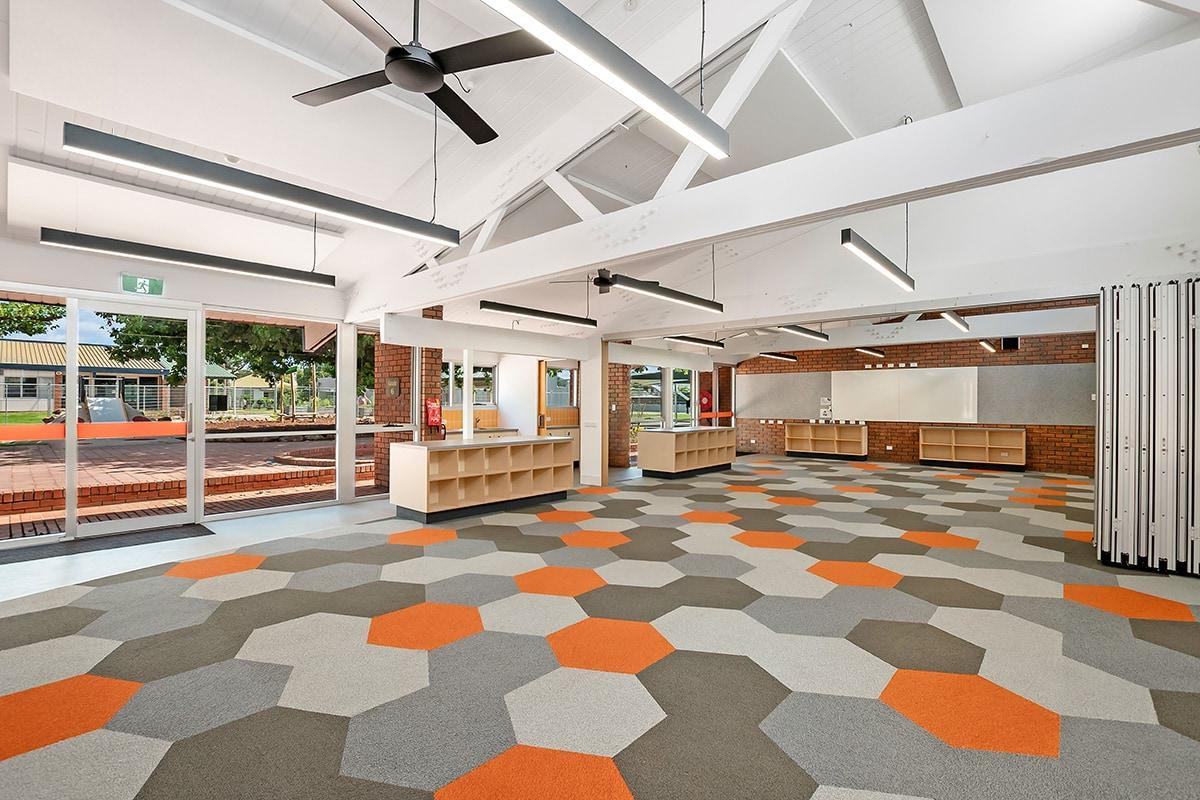
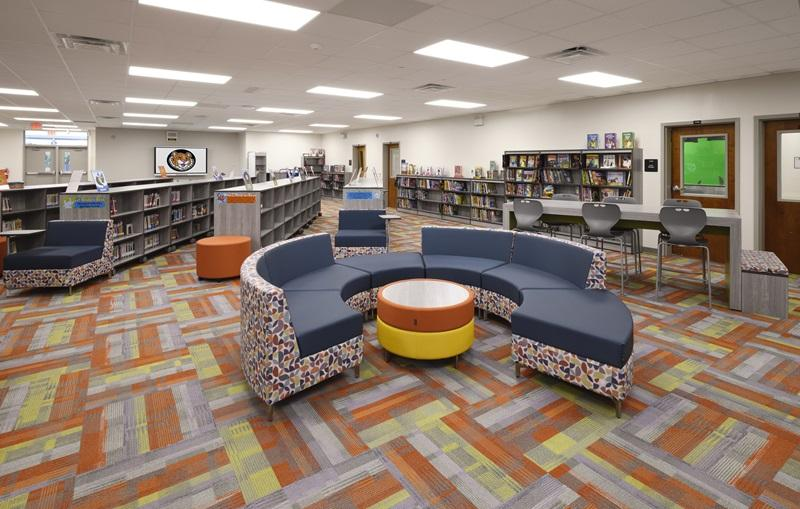
Pattern and color are not purely decorative decisions.
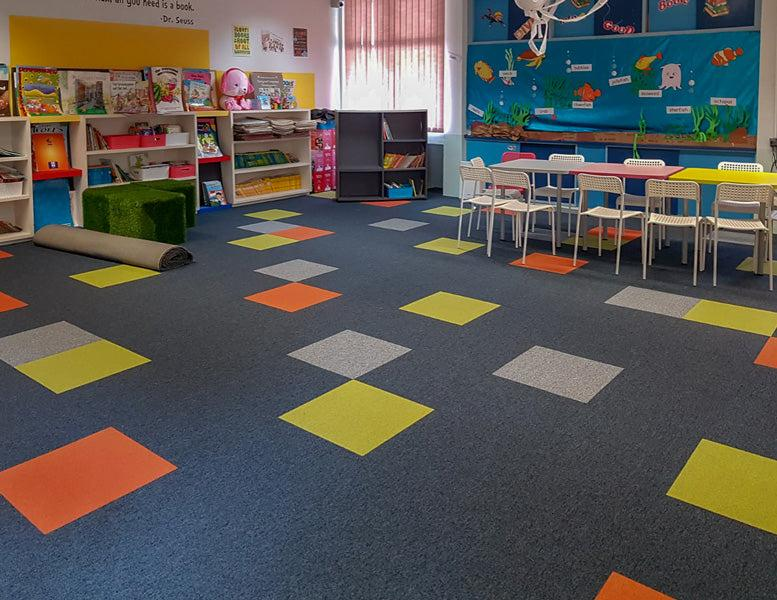
A carefully selected pattern can make everyday dirt and minor variations less visually obvious.
This does not replace cleaning or durability, but it can contribute to better long-term appearance.
For high-traffic corridors, buyers should therefore evaluate construction + color + pattern + maintenance, rather than considering appearance separately from performance.
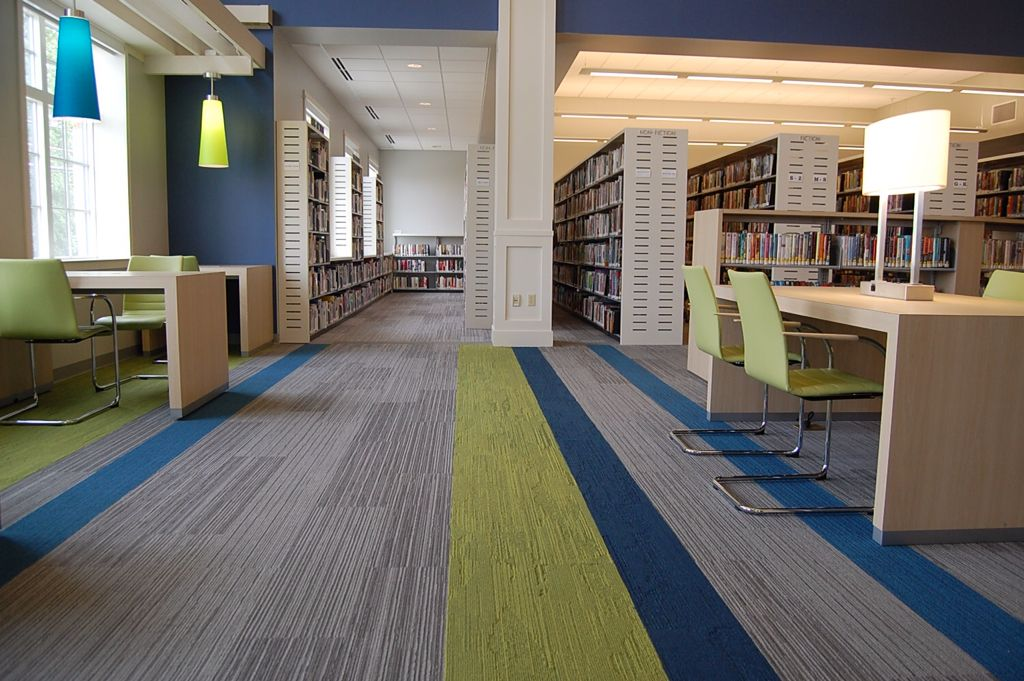
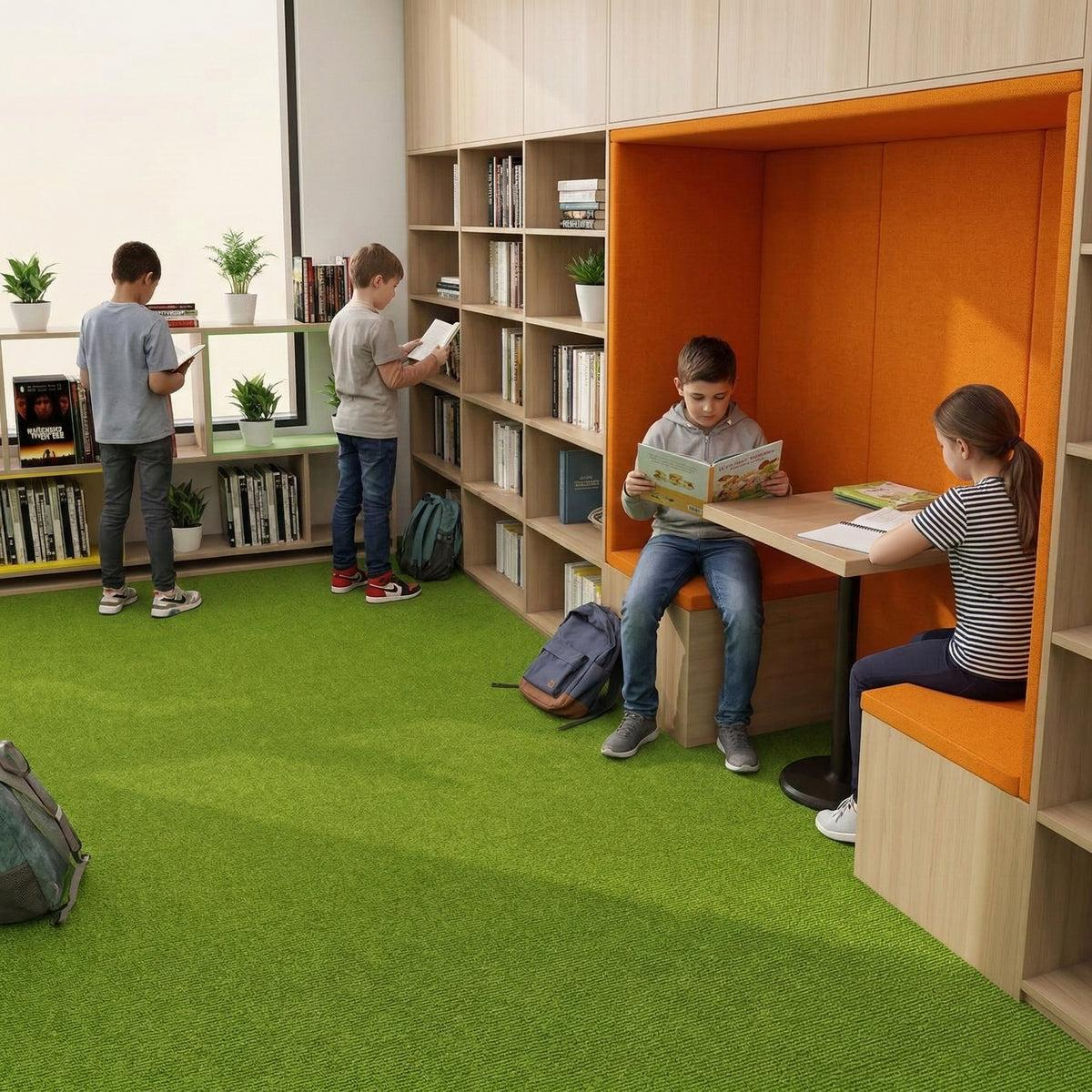
3. Carpet Tiles for School Libraries
Libraries require a different balance.
The environment is generally quieter and more relaxed than a corridor, but the flooring still needs to tolerate regular use.
For a library, the decision may focus more heavily on:
Acoustic comfort
Walking comfort
Visual atmosphere
Furniture layout
Maintenance
Durability
Design
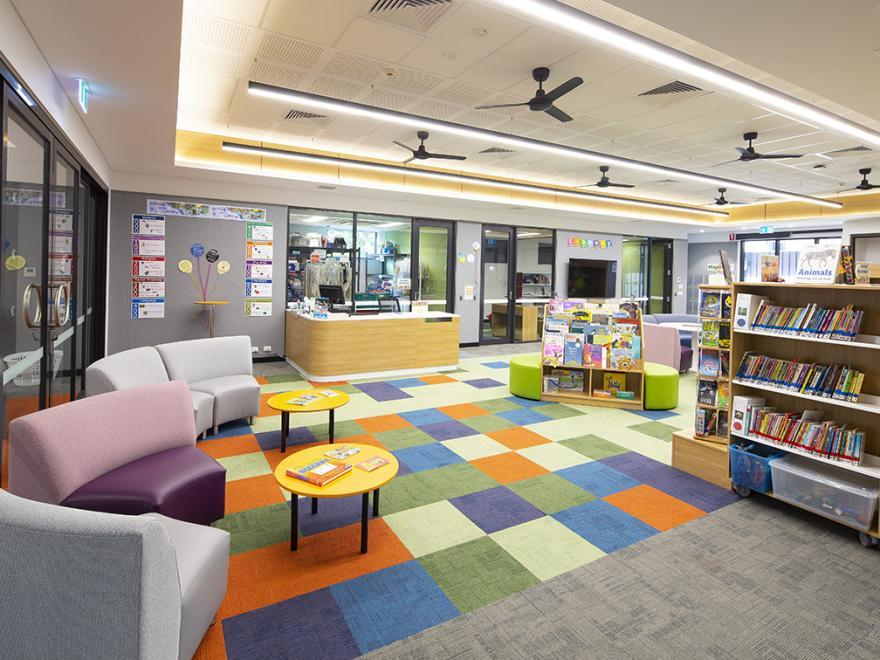
Carpet tiles can also make it easier to create visual zones within a library.
For example, different colors or patterns can visually distinguish:
Reading areas
Computer areas
Group study areas
Circulation zones
Informal seating areas
This can be achieved without physically separating the spaces.
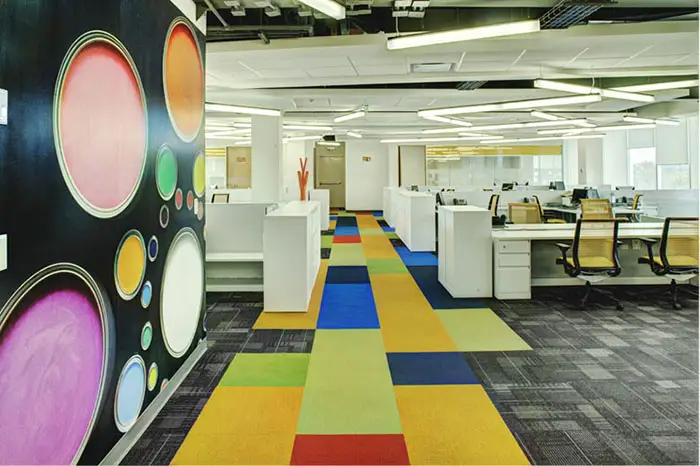
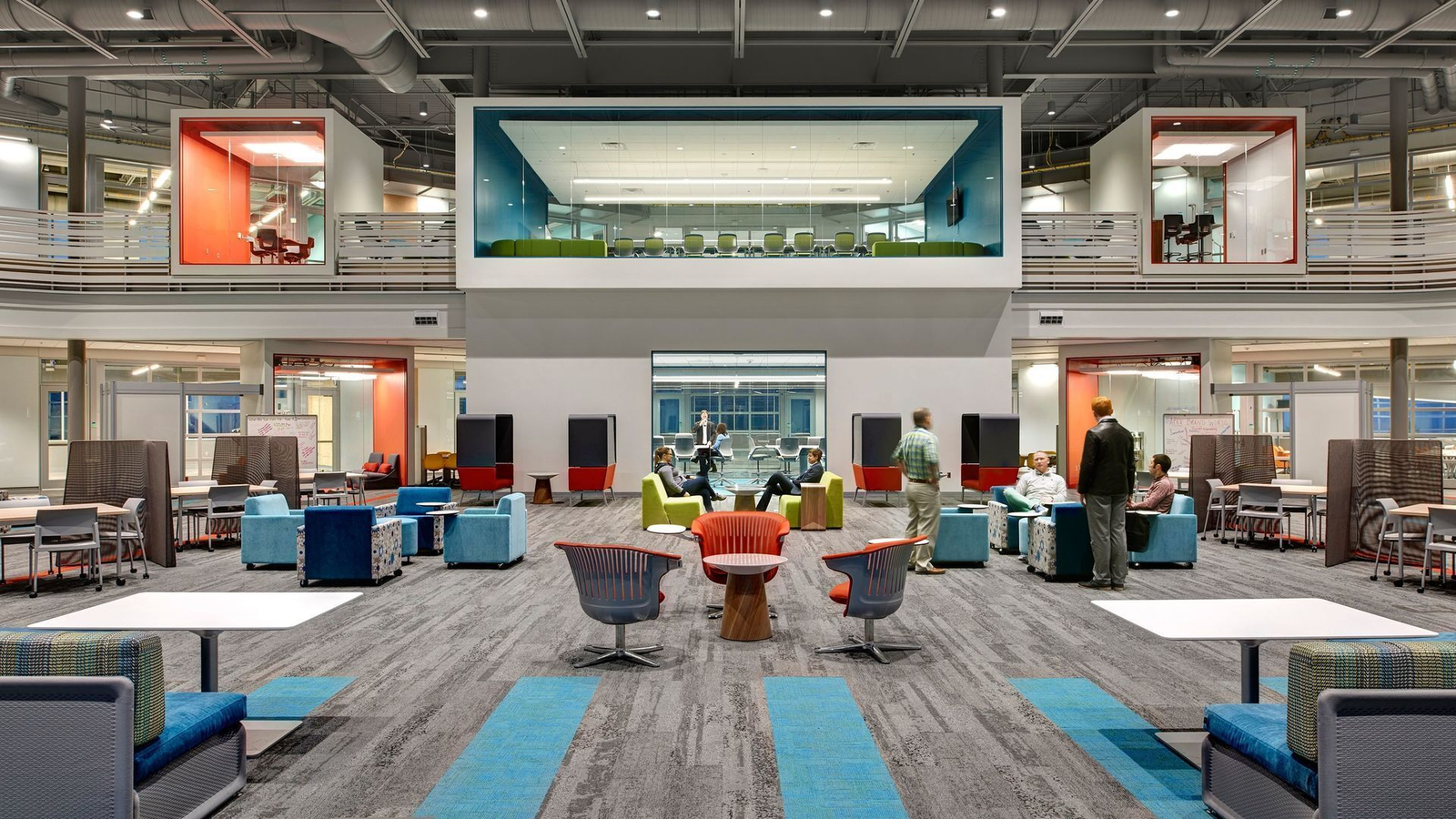
4. Carpet Tiles for Learning Commons and Collaborative Areas
Modern educational buildings increasingly include flexible spaces where students can:
Study independently
Work in groups
Move furniture
Use laptops
Hold presentations
Participate in collaborative activities
These spaces can experience unpredictable traffic patterns.
A conventional flooring specification based only on room type may therefore be insufficient.
Instead, consider how the space will actually be used.
For a learning commons, the carpet tile should be evaluated for:
Durability + flexibility + design + maintenance + replacement
Modular flooring can also provide an advantage when furniture layouts change.
If one section becomes more heavily used than expected, damaged or worn tiles can potentially be replaced locally instead of replacing the entire floor.
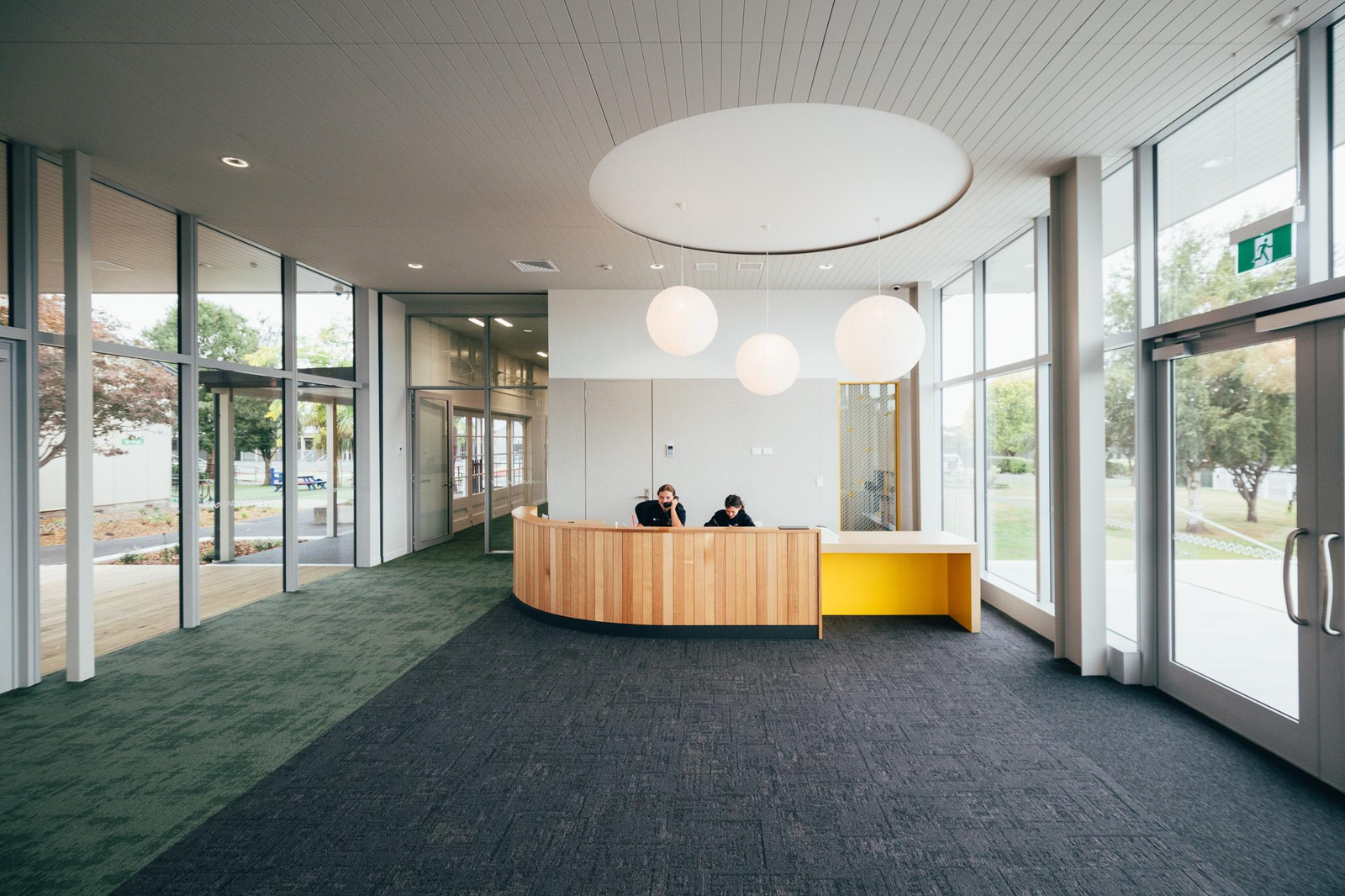
5. Carpet Tiles for School Reception Areas
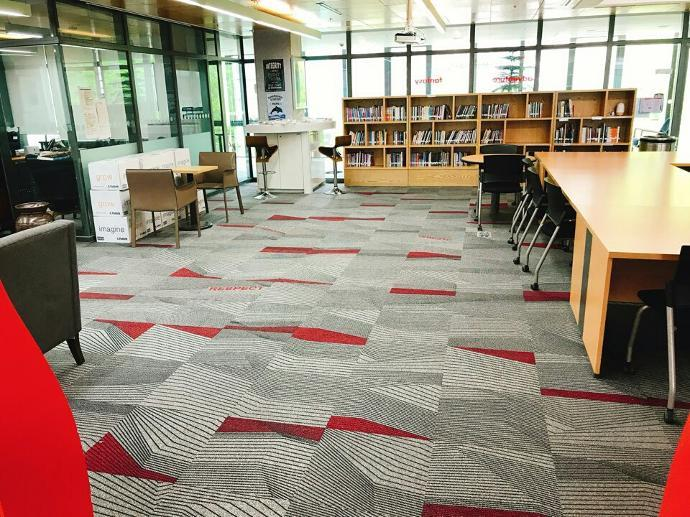
The reception area creates an important first impression for students, parents, teachers and visitors.
Here, flooring has both a functional and visual role.
A school reception may need to communicate:
Professionalism
Cleanliness
Modern design
Institutional identity
Durability
At the same time, it may experience significant traffic.
Therefore, choosing a carpet tile purely because it looks attractive in a sample book can be risky.
Ask:
How will this color and construction look after several years of real traffic?
The sample should be evaluated under realistic lighting and, where possible, alongside the wall, furniture and other finishes.
6. Carpet Tiles for Administration Offices
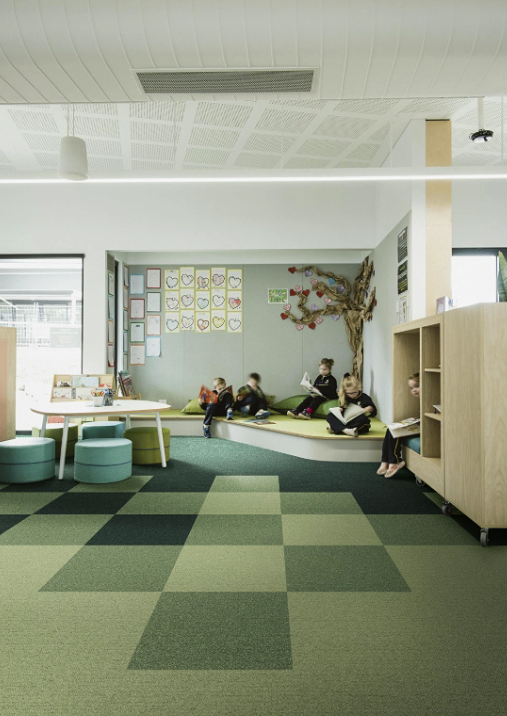
Administrative offices usually have more controlled traffic than corridors.
However, they still require flooring capable of handling:
Office chairs
Desks
Regular walking
Cleaning
Occasional furniture movement
Appearance may have a greater influence here because the space is often used for meetings with parents, suppliers, contractors and visitors.
Neutral colors, subtle textures and modular patterns are often easier to integrate with office furniture.
The important point is to balance appearance with actual performance requirements.
7. Carpet Tiles for Teacher Rooms and Staff Areas
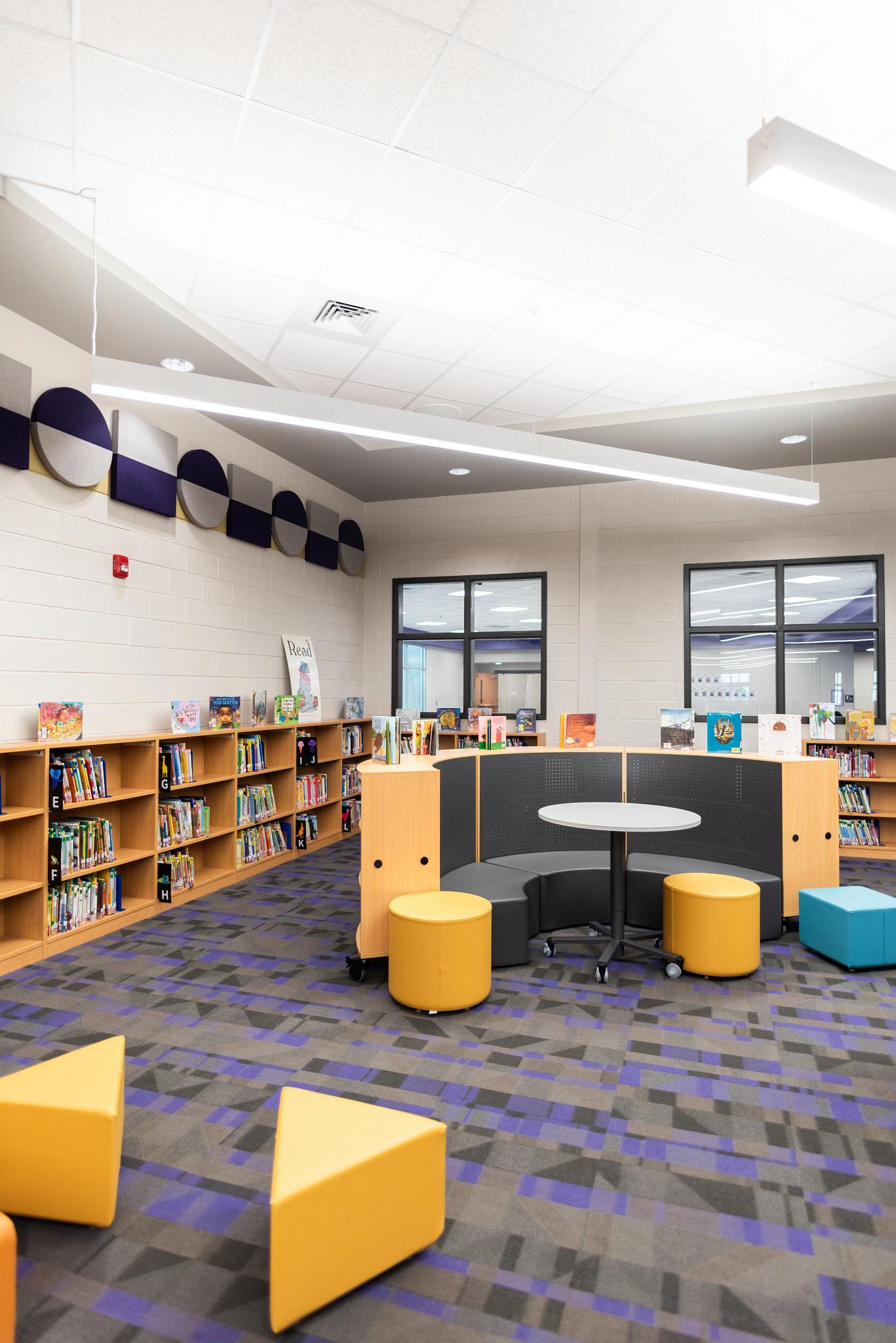
Teacher rooms and staff areas may have lower public traffic but can still experience intensive daily use.
The selection criteria can therefore be slightly different from those for corridors.
Depending on the project, priorities may include:
Comfort
Appearance
Easy maintenance
Moderate durability
Acoustic environment
Budget
If the same carpet tile is being used across several school areas, the specification should still be checked against the highest-demand application.
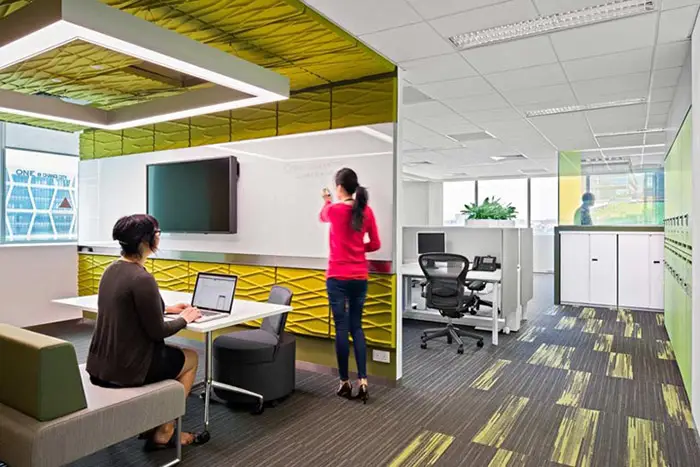
8. Carpet Tiles for Meeting and Conference Rooms
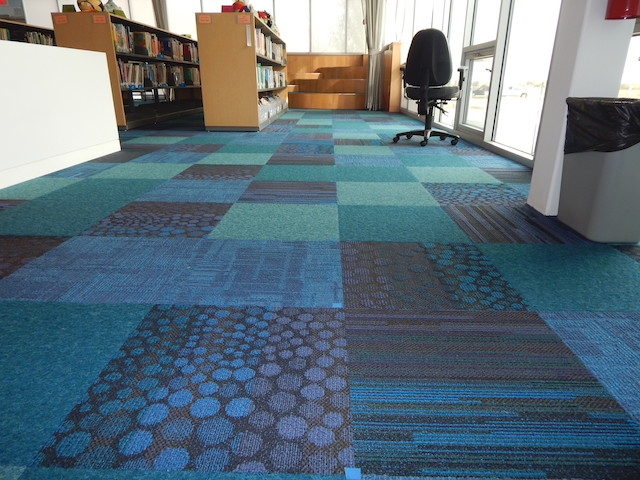
Meeting rooms generally have lower traffic than circulation spaces.
However, acoustics and visual quality can become more important.
A meeting room carpet tile should work with:
Tables
Chairs
Presentation equipment
Lighting
Wall finishes
Acoustic treatments
Color selection is particularly important because flooring occupies a large visual area.
For a professional education project, a subtle modular design can often provide a more sophisticated result than a completely uniform floor.
9. Carpet Tiles for School Entrances
Entrance areas require special attention.
Outdoor dirt, water and debris are frequently brought into the building through entrances.
This creates a very different flooring environment from an interior classroom.
Instead of automatically specifying the same carpet tile as the classroom, consider the complete entrance flooring system.
Important questions include:
Is there an entrance mat system?
How much outdoor dirt enters the building?
Is the carpet tile exposed directly to moisture?
How frequently will the area be cleaned?
Is the entrance connected directly to corridors?
Does the project require a transition between different flooring materials?
In many cases, the best result comes from designing the entrance and adjacent circulation areas as a connected system.
Understanding Carpet Tile Fiber: Nylon vs. Polypropylene vs. Polyester
One of the first technical questions buyers often ask is:
Which fiber is best for carpet tiles for schools?
There is no universal answer.
The appropriate fiber depends on the intended application, construction, traffic level, performance requirements and project budget.
Nylon Carpet Tiles
Nylon is widely used in commercial carpet applications because of its combination of durability and performance characteristics.
For school projects, nylon can be considered for areas where durability and long-term appearance are important.
Potential applications include:
Corridors
Classrooms
Libraries
Offices
Learning commons
High-use areas
However, the word “nylon” alone does not determine the performance of a carpet tile.
Two nylon carpet tiles can have substantially different specifications.
You should also examine:
Construction
Pile density
Pile height
Face weight
Total thickness
Backing
Dye method
Installation system
Polypropylene Carpet Tiles
Polypropylene can provide a cost-effective solution for certain commercial flooring applications.
It can be considered where project requirements and budget make it appropriate.
However, buyers should avoid selecting a carpet tile based solely on fiber price.
The more useful question is:
Does this specific construction meet the expected traffic, maintenance and service requirements of this zone?
For some projects, polypropylene may provide an appropriate balance between cost and performance.
Polyester and Blended Fibers
Polyester and blended constructions may also be available depending on the manufacturer and product range.
The correct decision should be based on the complete technical specification rather than the fiber name alone.
For a school project, the most important thing is to match the material to the actual use.
Fiber Is Only One Part of Carpet Tile Performance
A common procurement mistake is comparing products like this:
Product A = Nylon
Product B = Polypropylene
Therefore, Product A must be better.
This is too simplistic.
A commercial carpet tile is a complete flooring product.
Performance can depend on the relationship between:
Fiber + construction + pile + backing + density + installation + maintenance
For this reason, professional buyers should request the complete technical data sheet rather than relying on a product name or marketing description.
Carpet Tile Construction: What Should Buyers Check?
The construction of a carpet tile affects how the product behaves under daily use.
Important specifications can include:
Pile construction
Common commercial carpet tile constructions may include:
Tufted
Loop pile
Cut pile
Multi-level loop
Patterned constructions
Loop constructions are frequently considered for commercial applications because of their appearance and practical characteristics, but the correct choice depends on the specific product and project.
Pile height
Pile height affects appearance, texture and product construction.
Higher pile is not automatically better.
For school environments, the goal is usually to find a construction appropriate for the intended traffic and maintenance conditions.
Face weight
Face weight can be useful when comparing products, but it should not be used as the only measure of quality.
A heavier product is not automatically the best product.
Buyers should consider face weight together with construction, density, fiber, backing and performance data.
Carpet Tile Backing: One of the Most Important Specifications
If fiber is the visible surface of a carpet tile, backing is an important part of its structural system.
Commercial carpet tiles may use different backing technologies, including PVC and other backing constructions.
For school projects, backing can influence:
Dimensional stability
Installation
Tile handling
Moisture considerations
Overall construction
Replacement
Floor performance
The correct backing depends on the project conditions.
For example, a school renovation project with an existing subfloor may have very different requirements from a newly constructed education building.
Therefore, the question should not simply be:
“Which backing is best?”
Instead ask:
“Which backing system is appropriate for this product, subfloor, traffic level and installation method?”
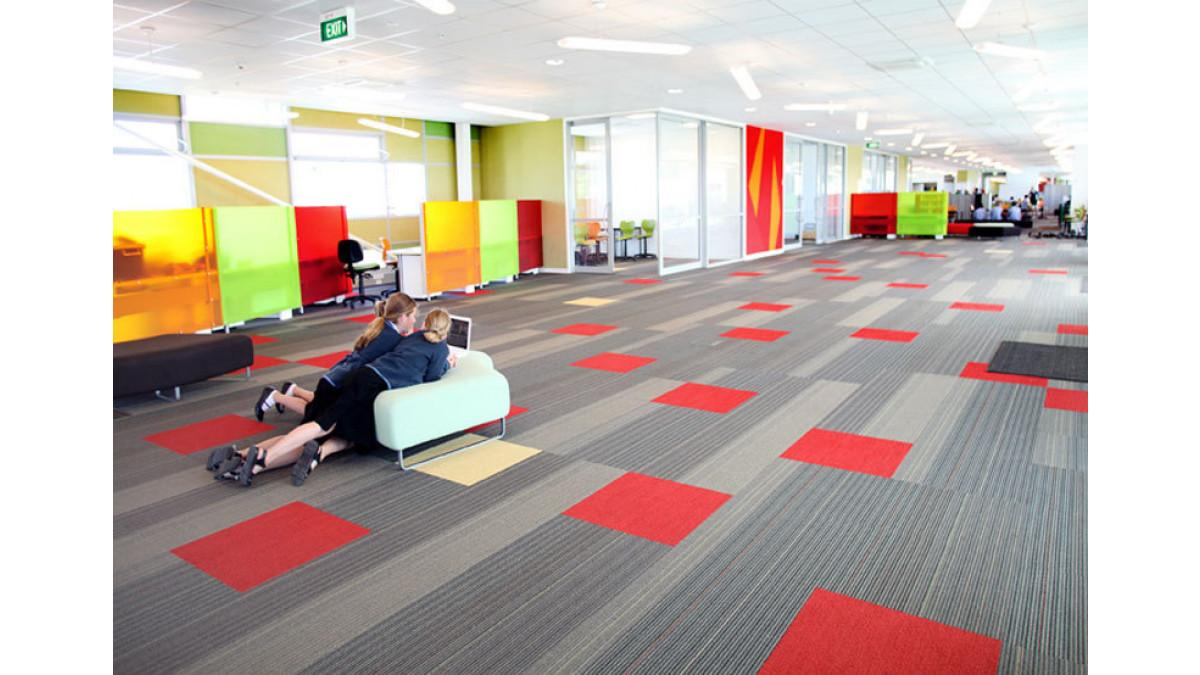
How to Choose Carpet Tiles for Schools by Traffic Level
Traffic should be one of the first factors considered.
A useful approach is to classify each area into:
Low Traffic
Examples:
Small staff rooms
Private offices
Low-use meeting rooms
Medium Traffic
Examples:
Classrooms
Libraries
Administration offices
Teacher rooms
Heavy Traffic
Examples:
Main corridors
Learning commons
Major circulation areas
High-use classrooms
Very Heavy or High-Dirt Traffic
Examples:
Main entrances
Areas immediately adjacent to outdoor access
Major circulation junctions
The exact classification should be based on the actual project rather than simply the room name.
A small classroom with 40 students may experience more intense use than a large office.
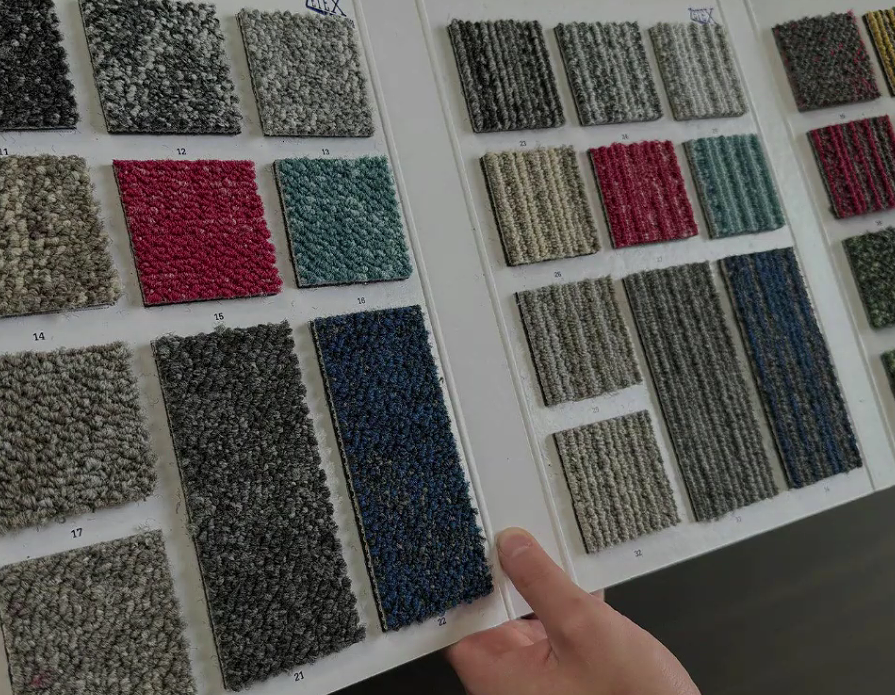
Color and Pattern: More Than an Aesthetic Decision
When selecting carpet tiles for schools, color is often treated as an interior-design issue.
It can also affect long-term visual maintenance.
Very uniform, light-colored floors may make dirt and staining more noticeable.
Very dark, solid floors can also reveal certain marks or dust.
Patterned carpet tiles can sometimes help visually integrate minor variations in appearance.
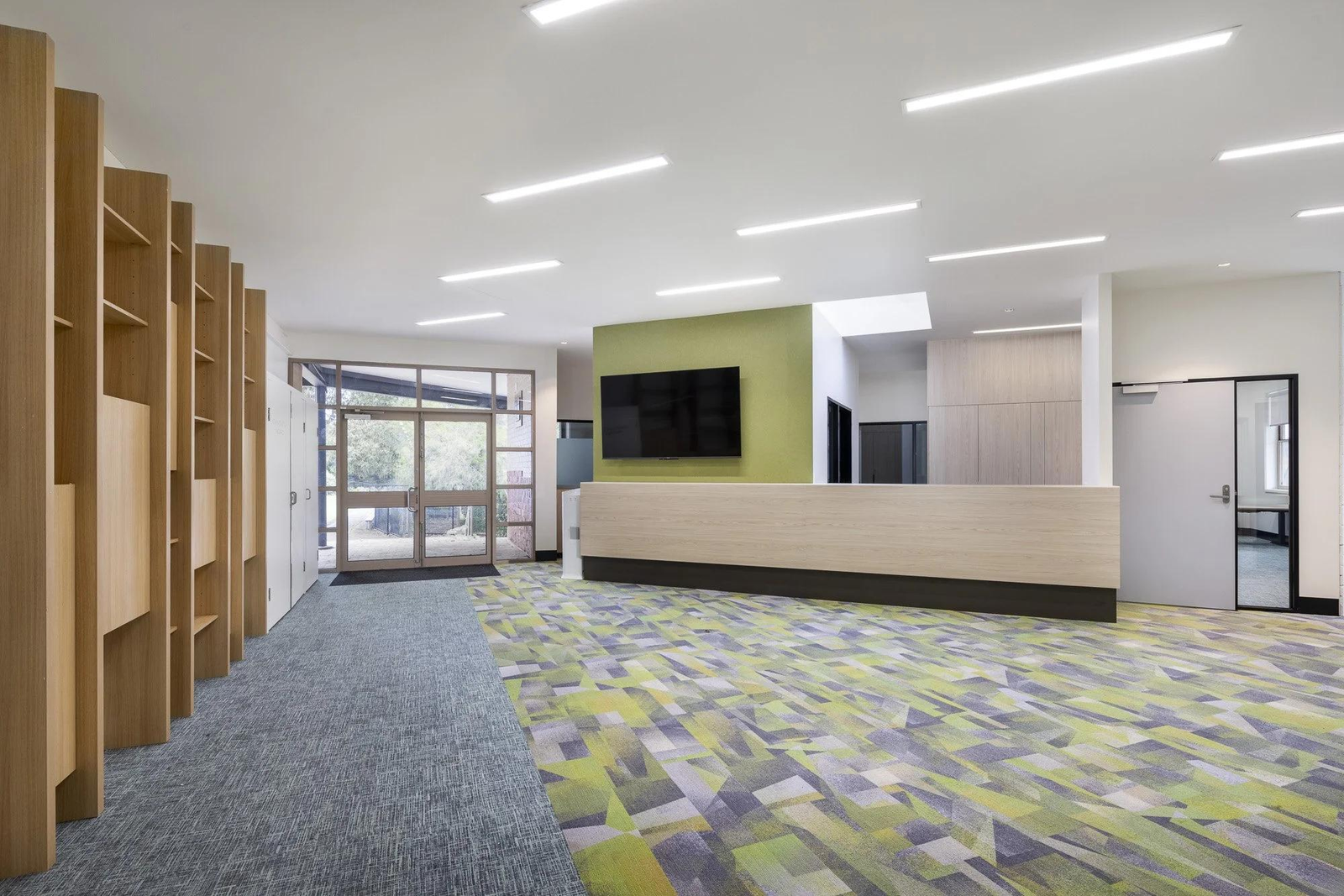
Color can also support wayfinding.
For example:
Blue zones for quiet areas
Grey tones for circulation
Accent colors for collaborative spaces
Different patterns for learning zones
This allows flooring to contribute to the building’s interior architecture.
Cleaning and Maintenance of School Carpet Tiles
No carpet tile is maintenance-free.
Even high-quality commercial carpet tiles require an appropriate maintenance program.
A school environment can expose flooring to:
Dirt
Dust
Food
Drinks
Mud
Ink
Outdoor contaminants
Furniture marks
A practical maintenance program may include:
Daily or routine cleaning
Regular vacuuming can remove loose dirt before it becomes embedded.
Immediate spill treatment
Spills should be addressed as soon as practical.
Periodic deep cleaning
The appropriate method depends on the carpet tile construction and manufacturer’s maintenance instructions.
Damaged tile replacement
One of the major advantages of modular flooring is the possibility of replacing individual damaged tiles.
However, replacement should follow the manufacturer’s installation recommendations.
Why Replacement Matters in School Flooring
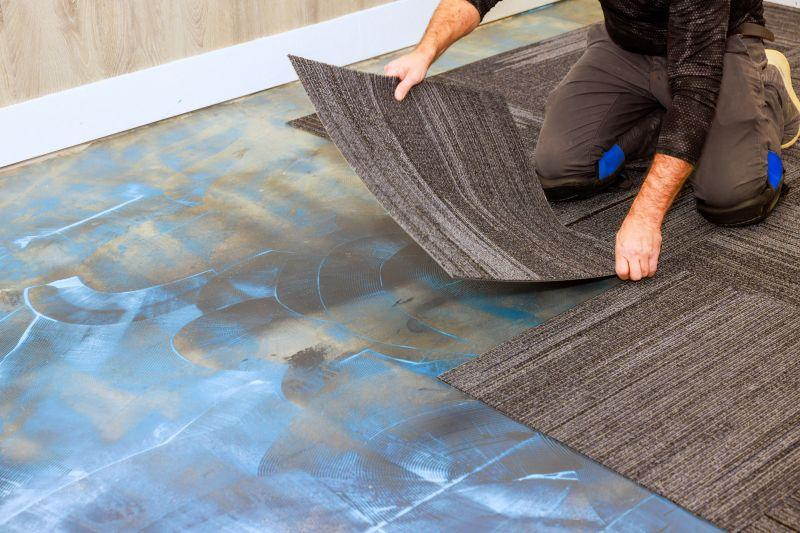
Imagine a school corridor where five carpet tiles are damaged.
With a conventional broadloom carpet system, repairing a small area may be complicated.
With modular carpet tiles, the damaged modules can potentially be removed and replaced.
This is particularly useful in environments where localized damage is unavoidable.
However, there is an important procurement consideration:
Buy replacement stock at the beginning of the project.
The exact color and dye lot of a carpet tile may not always be available years later.
For this reason, schools and contractors should consider purchasing attic stock or spare tiles during the original procurement.
The required quantity depends on:
Total installation area
Traffic
Expected damage
Product availability
Project maintenance strategy
Your carpet tile manufacturer can help determine an appropriate spare quantity.
How to Evaluate Carpet Tile Samples Before Approving Them
A sample book is not enough.
A small carpet tile sample can look completely different from a large installed floor.
Before approving a product, examine the sample for:
1. Color
Review the sample under the actual project lighting where possible.
2. Texture
Check the surface construction and pile.
3. Backing
Look at the actual backing construction rather than only the top surface.
4. Thickness
Compare the technical specification with the physical sample.
5. Installation appearance
If possible, review several tiles together rather than evaluating only one.
6. Cleaning behavior
For critical projects, discuss actual maintenance requirements with the manufacturer.
7. Adjacent materials
Place the carpet tile next to:
Wall finishes
Furniture
Vinyl
Wood
Ceramic tile
Entrance flooring
This provides a much more realistic impression of the final interior.
Don’t Approve Carpet Tiles Based Only on Marketing Claims
This is particularly important for commercial and education projects.
Words such as:
Commercial grade
School grade
Heavy duty
Durable
Easy to clean
Eco-friendly
High performance
are useful marketing descriptions, but they do not replace technical information.
For procurement, try to identify the exact:
Product series
Product code
Colorway
Size
Fiber
Construction
Pile
Thickness
Backing
Installation method
Applicable test reports
Current technical documents
This creates a much stronger specification.
What Documents Should You Request From a Carpet Tile Manufacturer?
For a commercial school project, consider requesting a complete technical information package.
Depending on the project, this may include:
Product data sheet
Technical specification
Installation instructions
Maintenance instructions
Fire performance information
Wear or durability test information
Relevant environmental documentation
Warranty information
Color and sample information
Packaging details
Production information
The important point is not simply collecting documents.
The documents should correspond to the exact product being supplied.
A general factory certificate does not automatically prove that every carpet tile in the factory has identical characteristics.
Carpet Tiles for Schools: New Construction vs. Renovation
The selection process can also change depending on the project type.
New Construction
For new schools, buyers can consider flooring as part of the complete interior system.
This allows better coordination between:
Subfloor
Carpet tile
Wall finishes
Doors
Furniture
Lighting
Acoustic design
Entrance systems
Renovation
Renovation projects are often more complicated.
Existing conditions may include:
Uneven subfloors
Existing adhesive
Moisture issues
Old flooring
Height differences
Door clearance problems
Existing transitions
Therefore, a carpet tile that works perfectly in a new construction project may require additional preparation in a renovation.
Always evaluate the existing floor before finalizing the installation system.
How Much Do Carpet Tiles for Schools Cost?
Price is important, but purchase price should not be the only metric.
The total cost can include:
Carpet tile + transportation + installation + floor preparation + maintenance + replacement + waste
For example, a cheaper carpet tile may become more expensive if:
It requires more frequent replacement
Installation is difficult
Waste is high
Cleaning is complicated
Spare tiles are unavailable
The product is discontinued quickly
This is why professional buyers should consider life-cycle cost, not just initial unit price.
How to Reduce Carpet Tile Waste in School Projects
Modular flooring can provide an advantage during installation because individual pieces can be cut around:
Columns
Door frames
Corners
Irregular walls
Fixed furniture
Access panels
However, the amount of waste still depends on the room geometry and installation layout.
Before ordering, consider:
Tile orientation
Pattern repeat
Room dimensions
Cutting requirements
Installation direction
Different color zones
For larger projects, a professional installer can calculate the required quantity more accurately.
Can Different Carpet Tile Colors Be Used in One School?
Yes.
In fact, using multiple colors can be an effective design strategy.
Instead of treating the entire school as one continuous floor, designers can create visual zones.
For example:
Classrooms: neutral and calming tones
Corridors: darker or patterned tiles
Libraries: softer, warmer visual palette
Learning commons: stronger accent colors
Reception: branded or feature flooring
This approach can make the building easier to navigate while giving different spaces their own identity.
Common Mistakes When Buying Carpet Tiles for Schools
Mistake 1: Choosing only by price
The lowest unit price does not necessarily produce the lowest project cost.
Mistake 2: Using one specification everywhere
Different areas have different traffic and maintenance requirements.
Mistake 3: Comparing only fiber
Nylon vs. polypropylene is not enough.
Construction and backing also matter.
Mistake 4: Trusting “commercial grade” as a complete specification
The exact product identity and technical data should be confirmed.
Mistake 5: Approving only one small sample
Always consider how multiple tiles will look together.
Mistake 6: Ignoring installation conditions
Subfloor preparation can affect the final result.
Mistake 7: Forgetting spare tiles
Future replacement becomes much easier when matching tiles are available.
Mistake 8: Ignoring maintenance
A flooring product should be evaluated together with its expected cleaning requirements.
Mistake 9: Selecting flooring without considering adjacent materials
Transitions between carpet tile and other flooring systems should be considered during design.
A Practical Carpet Tile Specification Checklist for Schools
Before approving a carpet tile, use this checklist.
Project Information
School type identified
New construction or renovation confirmed
Installation areas mapped
Traffic levels identified
Existing subfloor inspected
Product Information
Exact product series confirmed
Product code confirmed
Colorway confirmed
Tile size confirmed
Fiber confirmed
Construction confirmed
Pile specification reviewed
Thickness confirmed
Backing confirmed
Performance
Traffic requirement reviewed
Cleaning requirements reviewed
Stain considerations reviewed
Acoustic objectives considered
Fire requirements reviewed where applicable
Relevant test documentation reviewed
Installation
Installation method confirmed
Subfloor requirements confirmed
Adhesive/system compatibility confirmed
Direction/layout confirmed
Transition details reviewed
Procurement
Sample approved
Technical documents received
Warranty reviewed
Packaging confirmed
Lead time confirmed
Spare/attic stock considered
Final quantity calculated
This checklist can help designers, contractors, distributors and school procurement teams avoid making decisions based on incomplete product information.
How to Compare Carpet Tile Suppliers for a School Project
Choosing the product is only part of the process.
The supplier also matters.
Before placing a large order, ask the manufacturer:
1. Do you manufacture the product directly?
A direct manufacturer may be able to provide more detailed information about production, specifications and customization.
2. Can you provide samples?
A professional supplier should be able to provide physical samples for project approval.
3. Can you provide technical documents?
Ask for product-specific documentation rather than generic company certificates.
4. Can you support custom colors?
This can be important for education projects with specific design requirements.
5. What is your production capacity?
For large school projects, production capacity can affect delivery schedules.
6. Can you provide spare tiles?
This should be discussed before the initial order.
7. What is the lead time?
Confirm production and shipping schedules before the project enters the installation stage.
8. Can you support installation?
Even if the manufacturer does not install the flooring, it should be able to provide appropriate installation instructions.
What Makes a Good Carpet Tile for Schools?
There is no single carpet tile that is “the best” for every school.
The better question is:
What is the best carpet tile for this specific school zone?
A suitable product should provide an appropriate balance of:
Durability
Maintenance
Design
Comfort
Acoustic considerations
Installation
Replacement
Budget
Technical compliance
The final decision should be based on the complete product specification and actual project requirements.
Frequently Asked Questions About Carpet Tiles for Schools
Are carpet tiles suitable for schools?
Yes. Carpet tiles can be suitable for many school environments, including classrooms, libraries, offices, learning commons and corridors, provided the selected product is appropriate for the intended traffic, maintenance and installation conditions.
What are the best carpet tiles for classrooms?
There is no universal answer. Classroom carpet tiles should generally be evaluated according to traffic, cleaning, comfort, acoustic objectives, construction, fiber and backing.
Are carpet tiles suitable for school corridors?
They can be, but corridor products should be selected according to the expected traffic level and maintenance requirements. High-traffic corridors should not automatically use the same specification as low-use rooms.
Are nylon carpet tiles better than polypropylene?
Not automatically. Nylon and polypropylene have different characteristics, and the overall performance of a carpet tile depends on more than fiber type. Construction, pile, backing and intended use should also be considered.
Can damaged school carpet tiles be replaced?
One of the main advantages of modular carpet tile flooring is that individual tiles can potentially be replaced. Keeping spare tiles from the original production can make future repairs easier.
How many spare carpet tiles should a school buy?
There is no universal percentage. The appropriate quantity depends on project size, traffic, expected damage, product availability and the school’s maintenance strategy. Discuss attic stock requirements with the manufacturer before ordering.
Are carpet tiles good for high-traffic school areas?
Some commercial carpet tiles are designed for demanding traffic environments, but the exact product specification should be checked. Do not assume that every carpet tile is appropriate for a high-traffic corridor simply because it is marketed as “commercial.”
What should I ask a carpet tile manufacturer before ordering?
At minimum, confirm the exact product identity, fiber, construction, pile, thickness, backing, dimensions, installation requirements, technical documentation, maintenance instructions, warranty, lead time and spare-tile availability.
Choosing Carpet Tiles for Schools: The Bottom Line
The most effective way to select carpet tiles for schools is to stop thinking of the school as one large flooring area.
Instead, divide the project into functional zones.
Start with:
1. Where will the carpet tile be installed?
2. How much traffic will the area receive?
3. What maintenance conditions should be expected?
4. What acoustic and design objectives are required?
5. Which fiber and construction are appropriate?
6. Which backing system fits the project?
7. How will the carpet tile be installed?
8. How will damaged tiles be replaced in the future?
9. What product-specific documentation is available?
10. Can the supplier maintain consistent quality and supply?
This approach produces a much more reliable flooring specification than choosing a product based on color, price or a generic “commercial grade” label.
Need Carpet Tiles for a School or Education Project?
FAMILAI supplies carpet tile solutions for commercial and institutional applications, with options including PVC-backed carpet tiles and different fiber and design configurations.
For school, office, hotel and other commercial projects, we can discuss requirements such as:
Carpet tile material
Fiber selection
PVC backing
Color and pattern
Tile specifications
Project quantity
Packaging
Samples
OEM/custom requirements
Production and delivery
If you are an architect, interior designer, contractor, distributor, project manager or commercial buyer sourcing carpet tiles for an education project, send us your project requirements.
Tell us the application area, approximate quantity, preferred material, color requirements and destination market — and our team can help you identify a suitable carpet tile specification.
FAMILAI — Carpet Tile Solutions for Commercial Projects
Website: www.hlyidacarpet.com